
Twin Cities Housing Market Has Most Closed Sales Since 2005
By Aubray Erhardt on Wednesday, January 20th, 2016
At a press conference today, REALTOR® associations reported that the Twin Cities Metropolitan Area had the best year in terms of the number of closed sales since 2005. Closed sales finished 2015 13.7% better than 2014, boasting 56,390 compared to 49,604 in 2014.
The median sales price in 2015 was $220,000, a 7.0% increase from $205,600 in 2014. This is on top of gains in recent years of +14.4% in 2013 and 11.9% in 2012. The median sales price of single family homes was up 5.6% and townhouse-condos were up 3.8% over the prior year, continuing multi-year positive trends. Distressed sales were a mere 10.6% of all closed sales in 2015. This represents a one-year change in sales of foreclosures and short sales of -26.7%.
“Last year (2015) really showcased the durability of our economic and housing recovery, despite a few obstacles. As sales hit a 10-year high, the Twin Citizens are just as committed to homeownership as ever. Attractive rates, rising rents, job growth, wage increases and the lowest unemployment rate of any major metro area will continue to be positive factors for real estate,” said Judy Shields, President of the Minneapolis Area Association of REALTORS®
Months’ supply of inventory ended the year at an unprecedented low of 2.1 months. This metric indicates how long it would take to sell-off all existing inventory if no new inventory was added and is generally considered balanced, favoring neither buyer nor seller, at 5.0 months. While this metric indicates a sellers’ market that may leave some buyers with fewer options, it also has some market watchers asking themselves whether we’ve seen the supply bottom. While inventory is certainly a metric to watch it’s probably best measured and compared throughout the selling season and not at year end.
“Since inventory conditions vary across the metro and market conditions change quickly, would-be sellers are encouraged to contact their REALTORS® for an updated market analysis. Your home might be worth more than you think,” said Bob Clark, President of the Saint Paul Area Association of REALTORS®.
Days on market continued to shrink, ending 2015 at just 76 days on the market – a 10-year record low.
Percent of original list price, a metric that demonstrates a relationship of the original list price compared to the final sales price remains strong at 96.6% overall and across market segments. For example, this means if a home was originally listed at $100,000 its final sales price was $96,600.
Single family homes and townhouse-condo segments were at 96.6% of original list. Previously owned was at 96.4%. New construction topped out a 99.6% of original list. This indicates sellers have regained their pricing power and are accepting near-full price offers on their listings.
“We know that well maintained, appropriately priced homes with amenities are selling fairly quickly but moreover the data shows that as well,” said Clark.
From The Skinny Blog.
Weekly Market Report

For Week Ending January 9, 2016
We are just getting started into 2016 residential real estate market activity, but early indicators are pointing to a positive start. Home sales are expected to have a healthy amount of growth in 2016, but along with the rise in sales, modest increases in home prices are also expected. Low mortgage rates are an unexpected ray of sunshine this week, amidst typical winter doldrums.
In the Twin Cities region, for the week ending January 9:
- New Listings increased 11.3% to 1,144
- Pending Sales increased 15.3% to 708
- Inventory decreased 20.8% to 10,293
For the month of December:
- Median Sales Price increased 9.9% to $219,900
- Days on Market decreased 12.4% to 78
- Percent of Original List Price Received increased 1.3% to 95.4%
- Months Supply of Inventory decreased 31.3% to 2.2
All comparisons are to 2015
Click here for the full Weekly Market Activity Report. From The Skinny Blog.
Weekly Market Report
For Week Ending January 2, 2016
Optimism is in the air as we turn to face a new calendar year. As far as residential real estate goes, there is plenty to feel positive about. Buying and selling activity continued through the final months of 2015, and there’s little reason to believe that trend will slow down during the first month of 2016. If anything, the past few years have indicated a tendency for listings and sales to increase in January.
In the Twin Cities region, for the week ending January 2:
- New Listings decreased 24.8% to 416
- Pending Sales increased 2.2% to 550
- Inventory decreased 19.5% to 11,175
For the month of December:
- Median Sales Price increased 9.9% to $219,900
- Days on Market decreased 12.4% to 78
- Percent of Original List Price Received increased 1.4% to 95.5%
- Months Supply of Inventory decreased 34.4% to 2.1
All comparisons are to 2015
Click here for the full Weekly Market Activity Report. From The Skinny Blog.
Weekly Market Report
For Week Ending December 26, 2015
As another year winds down, we’ll be looking toward 2016 with increased interest in changes in trend lines. But as we’ve seen over the last several months, and now beginning to become multiple years, the trends have been pretty steady. The prevailing thought by national market watchers is that 2016 will largely mirror 2015 but at a more even pace. The continuation of Fed rate increases are expected to keep things in check, but the funny thing about anticipating those increases is that it tends to inspire more activity. Happy New Year!
In the Twin Cities region, for the week ending December 26:
- New Listings increased 0.7% to 271
- Pending Sales increased 39.6% to 483
- Inventory decreased 19.3% to 11,519
For the month of November:
- Median Sales Price increased 6.8% to $219,040
- Days on Market decreased 7.6% to 73
- Percent of Original List Price Received increased 1.2% to 95.8%
- Months Supply of Inventory decreased 28.2% to 2.8
All comparisons are to 2014
Click here for the full Weekly Market Activity Report. From The Skinny Blog.
Weekly Market Report
For Week Ending December 19, 2015
A week after the Federal Reserve raised short-term interest rates to .25 percent to .5 percent, the average on a 30-year fixed mortgage dropped .01 percent from the previous week to 3.96 percent, proving for now that the Fed’s effect on long-term rates is indirect when inflation is low, among other factors. Some even believe that rate hikes mean much more to Wall Street observers than home buyers. Not everyone agrees with this assessment, but residential real estate is still certainly spinning on an active axis as we work our way to a new year.
In the Twin Cities region, for the week ending December 19:
- New Listings increased 1.3% to 601
- Pending Sales increased 17.2% to 799
- Inventory decreased 18.4% to 12,105
For the month of November:
- Median Sales Price increased 6.8% to $219,040
- Days on Market decreased 7.6% to 73
- Percent of Original List Price Received increased 1.2% to 95.8%
- Months Supply of Inventory decreased 28.2% to 2.8
All comparisons are to 2014
Click here for the full Weekly Market Activity Report. From The Skinny Blog.
December Monthly Skinny Video
Weekly Market Report
For Week Ending December 12, 2015
This year, it is projected that 46.1 percent of holiday shopping will be done online, up from 44.4 percent last year. As American consumers continue to change the way they buy things, we’re already seeing massive upheaval in long-entrenched ways of going about this thing called life. Fewer people are driving, or even buying cars for that matter, which allows sharing-economy companies like Uber and Zipcar to exist. Fewer people are going to department stores and malls, which allows home-shipping giants like Amazon to exist. One day soon, even home purchases will happen in a vastly different way. Are you ready for what’s next?
In the Twin Cities region, for the week ending December 12:
- New Listings increased 8.0% to 715
- Pending Sales increased 16.8% to 777
- Inventory decreased 17.9% to 12,536
For the month of November:
- Median Sales Price increased 6.9% to $219,080
- Days on Market decreased 7.6% to 73
- Percent of Original List Price Received increased 1.2% to 95.8%
- Months Supply of Inventory decreased 28.2% to 2.8
All comparisons are to 2014
Click here for the full Weekly Market Activity Report. From The Skinny Blog.
Asking All the Rate Questions
By David Arbit on Monday, December 14th, 2015
By David Arbit, Director of Research & Economics
Abstract: There is no question we are in a rising interest rate environment. The Fed may begin to normalize rates starting in December 2015. Inflation has been low, jobs numbers have been strong, wage growth is accelerating, unemployment has fallen dramatically and the U.S. is one of the few bright spots in today’s global economy. The process of rate normalization will be slow and incremental—the Fed is well aware that raising rates too quickly could threaten the recovery. It’s important to remember that there are many factors affecting consumer-facing rates other than Fed policy. Moreover, rising wages and an improving labor market could offset some of the declining affordability brought on by marginally higher rates and rising home prices. Keeping rates this low for too long poses its own set of risks. It’s tempting to be blinded by the recent past, but many consumers were lining up to get mortgages at 17.0% or higher only a few decades ago. Ultimately, higher interest rates are unlikely to derail the recovery and could even deliver some positive outcomes.
Precisely six years and six months after the official end of the Great Recession, the Federal Reserve (Fed) finally seems poised to normalize what have been the lowest interest rates in 50 years. Rates have remained low in an effort to help spur borrowing and growth for businesses and consumers, and they’ve mostly accomplished that goal without the rampant inflation feared by some hawks. That said, leaving rates this low for too long poses its own set of risks. There is a somewhat delicate balancing act.
What exactly does the Fed do? By law, the Fed has a dual mandate: maximum employment and price stability in the form of mild inflation. Excluding a bit of volatility here and there (mostly food and energy), there has been a good deal of progress on both fronts. As the Fed signals that they’re confident enough in the economy’s ability to withstand higher rates, most consumers should feel good about that assessment. Consumers—particularly prospective home buyers—should also understand that mortgage rates are expected to remain below average for years to come. In other words, some will undoubtedly rush to close on a property so they can brag about a sub-4.0% interest rate at backyard barbecues but the reality is that mortgage rates will remain attractive for some time.
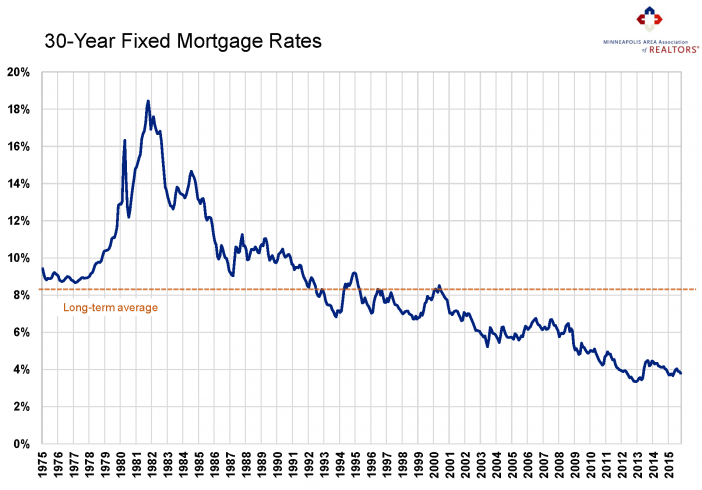
Just what has been the trend with mortgage rates? As the trendline above indicates, mortgage rates have been declining for the last 35 years. They hit a high of 18.5% in 1981 and a 50-year low of 3.3% in 2012, compared to a long-term average of about 8.0%. Many consumers benefited from 30-year mortgage rates below 4.0% between 2012 and 2015. This spurred a lot of refinancing activity in addition to first-time and move-up home buyer purchase activity.
In fact, sales in the 13-county Twin Cities metro area reached a 10-year high in June 2015, no doubt partly triggered by low rates. But what will be the impact of higher (or more normal) rates on our economic recovery, the housing market, savings yields and the stock market? Higher rates aren’t all bad. It means savers will be rewarded more, which will be a positive factor for down payments and consumer financial stability. The economic recovery is accelerating as we’re seeing strong jobs numbers, finally stronger wage growth and consistent GDP growth. Higher rates are unlikely to derail the recovery.
The stock market has begun to price in higher interest rates, but stocks have been quite popular since other investment vehicles aren’t yielding much return due to the rate environment. That could be an area of concern. But the fundamentals remain compelling. Corporate profits near all-time highs, corporate taxes near all-time lows, record valuations driving unprecedented merger and acquisition activity—higher than even the debt-fueled M&A boom before the recession—all suggest the U.S. corporate sector and economy in general will remain an island of stability in a global sea of potential risks.
On the housing side, refinancing activity will likely slow, but there is enough organic and pent-up demand out there to support ongoing housing recovery. Many families chose to stay put and weather the downturn. Some adult children who doubled up with mom and dad will forge their own new households. Many renters frustrated by rising rents will enter homeownership to gain equity and better control their housing costs. Price growth should remain positive but the pace has already slowed and returned to historic norms (+4.0% to +7.0% year-over-year). In 2013, the median sales price increased 14.4% compared to 2012. For 2014, that figure was 7.1%, and for 2015YTD it is 7.0%.
So what happens next? The Fed has limited yet effective tools available at its disposable to implement monetary policy. Through open market operations, the discount rate and reserve requirements, it is able to alter the federal funds rate. This is the key rate at which financial institutions (banks, credit unions) actively trade balances held at the Fed with each other. This usually happens overnight and impacts a variety of financial vehicles, including mortgage rates.
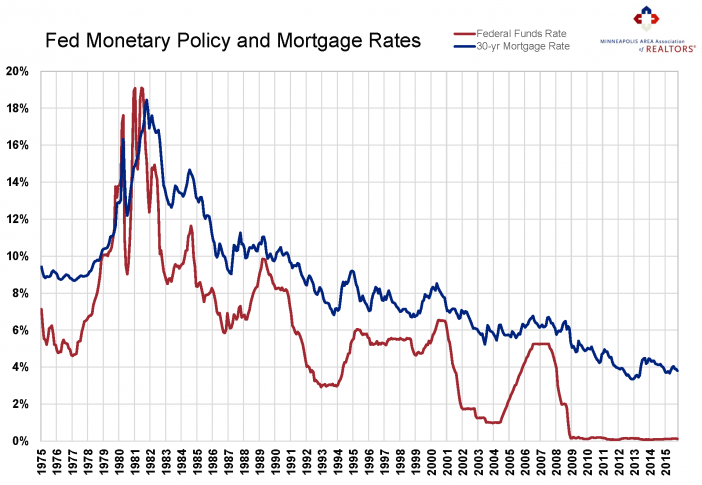
However, a shift in the federal funds rate does not correspond to an equivalent change in the consumer-facing 30-year mortgage rate. The chart above showcases this. Note that large increases in the federal funds rate only correspond to minor and sometimes leading or lagging changes in the mortgage rate. There does seem to be a relationship, but it’s neither as strong nor as direct as many assume.
For example, when the federal funds rate increased from 1.0% to 5.2% between 2004 and 2006, mortgage rates only increased from 5.5% to around 6.5%. In other words, a 420.0% increase in the federal funds rate was only accompanied by a roughly 18.0% increase in rates. That was an unusually large jump in the federal funds rate aimed at slowing an overheating housing market. None of this happens in a vacuum. Many other factors impact mortgage rates, including but not limited to current inflation, future inflation expectations, treasury market dynamics, equity and bond market dynamics, debt levels, the velocity of money, wage pressure, GDP growth, the general economic climate and other forces.
So exactly what does the future hold? Crystal balls are tough to come by these days, but Freddie Mac and others have put out a forecast for mortgage rates through the end of 2016.

Most economists expect 30-year mortgage rates to reach 4.5% or 4.6% by the end of 2016, compared to just under 4.0% at the end of 2015. That’s a manageable increase and is still well below the long-term average of just over 8.0%. To put that in perspective, the total payment on a $200,000 loan at 4.0% vs. 4.5% amounts to a monthly difference of about $50. While that’s certainly noticeable, most households can stomach it—particularly with additional wage growth and stronger labor force participation.
In the face of declining affordability brought on by rising prices and higher rates, the key will be whether wage growth can neutralize or at least partly offset that effect. Furthermore, in today’s low inventory environment, the other trend to watch will be whether prices continue to rise at a sufficient level to motivate hesitant sellers to list without rising so fast so as to alienate buyers. The most budget-sensitive consumers might make an attempt to get deals done sooner than later, but for most consumers, the difference isn’t enough to drastically change behavior.
Ultimately, the future is unwritten. But given the data coming out of the economy, labor and housing markets and the fact that the dream of homeownership is alive and well, we feel pretty confident that the U.S. economy in general and housing in particular will remain a bright spot.
From The Skinny Blog.
Weekly Market Report
For Week Ending December 5, 2015
Low unemployment and cheap fuel are conspiring to help people spend money this holiday season, but not necessarily more than last year at this time. Early analysis of year-end shopping habits indicates a fairly average amount of purchases being made across the board, with items like clothing and electronics doing well, while automobiles and home goods are in mild sales decline. It all adds up to a mostly fiscally sound bunch of Americans who will not be coaxed into purchasing more than they want or can pay for. We have come a long way since the Great Recession, and the housing market is benefiting from smarter spending.
In the Twin Cities region, for the week ending December 5:
- New Listings increased 3.2% to 875
- Pending Sales increased 10.8% to 903
- Inventory decreased 16.7% to 13,097
For the month of November:
- Median Sales Price increased 7.3% to $219,900
- Days on Market decreased 7.6% to 73
- Percent of Original List Price Received increased 1.3% to 95.9%
- Months Supply of Inventory decreased 28.2% to 2.8
All comparisons are to 2014
Click here for the full Weekly Market Activity Report. From The Skinny Blog.
- « Previous Page
- 1
- …
- 154
- 155
- 156
- 157
- 158
- …
- 168
- Next Page »